Northwest Bush Blade

Northwest Bush Blade

Monday, March 7, 2011

Bucorp D2 fighter


© Jeff Crowner 2011


This blade is made off of one of Wayne Goddard's fighter patterns.  I have used a training version in my Kali classes with great success.  This blade is wonderful and light in the hand making it very quick.  The handle is deceptively comfortable in both grips.  I made this one out of Bucorp K110 (D2) steel.  The handles are red G10 from Alpha Knife Supply.  I am currently making some with OD Green G10.  Thanks once again Wayne for influencing me with the blade craft.  Wayne is pure genius.  Wayne Goddard has done more for the knife world than most anyone else.  We as knife makers owe him many thanks for the research and development done within this realm.  Thank you Wayne and Phyllis Goddard for being so giving to others.


© Jeff Crowner 2011
This blade is a Bucorp N-690 stainless steel fighter.  I have included filework on some OD Green G-10 handle slabs.  Everything is handmade and heat treated by myself.  I will have this one featured on my table N-12 at the OKCA knife show second weekend of April 2011.  Please stop by and take a look and pick it up.....

© Jeff Crowner 2011
This piece is a Bucorp K-110 (D2) fighter with G-10 scales.  This one has a very fast light feel due to the tapered tang on it.  I will get a pic later of the tapered tang.

Tuesday, February 8, 2011

Khukri "My take on it"


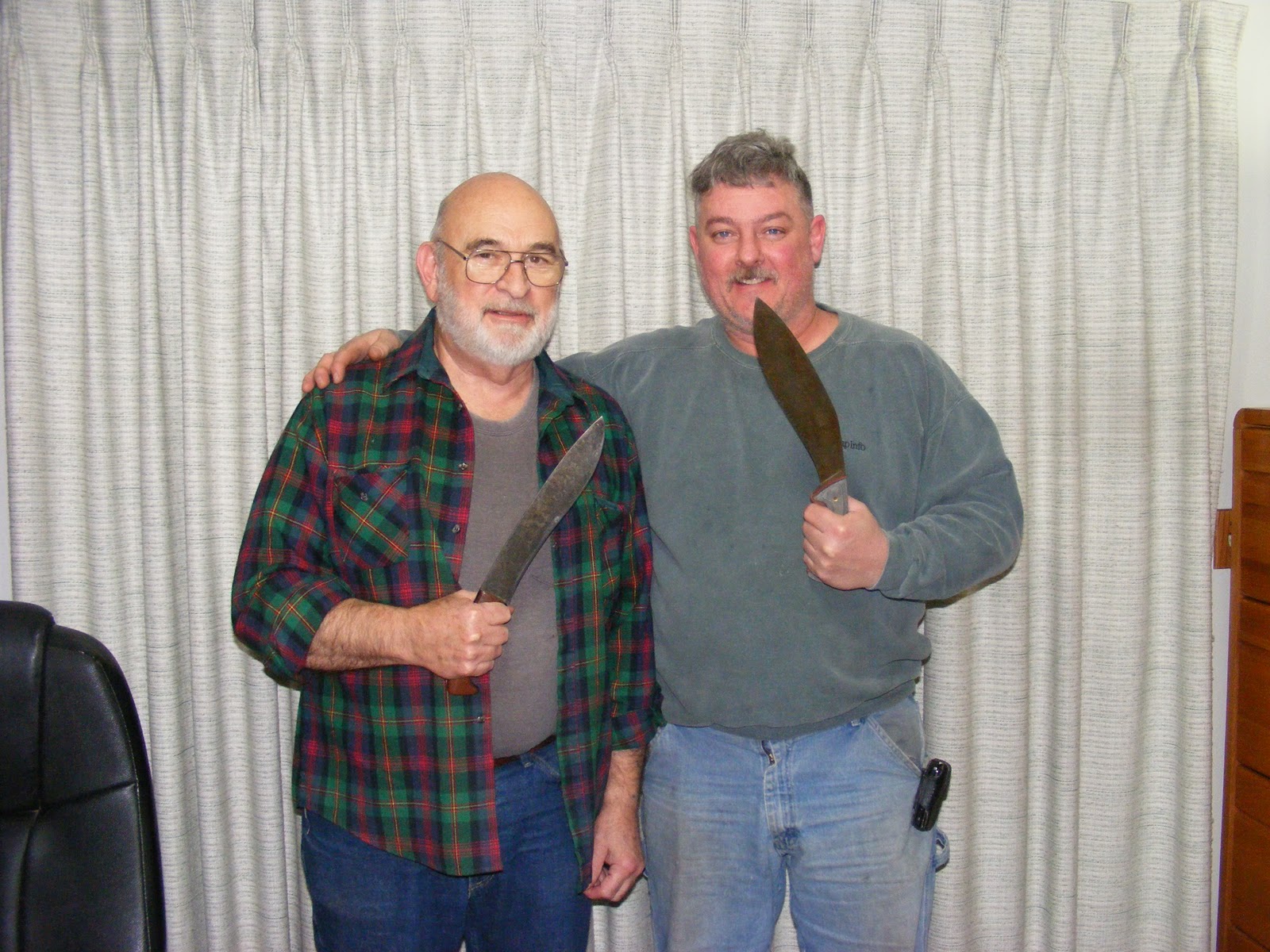
I pondered awhile on what would make a good Khukri for bushcraft and self defense.  I came up with this design first in a polycarbonate trainer blade which I used in my local Kali class for three months. The trainer felt comfortable in my hand and performed well so I made a few small refinements leading to what is the current profile of the real fixed blade. 

This thing really bites into wood very well.  For that matter the blade bites into just about anything you can throw at it.  It is very well balanced not wanting to twist in your hand when chopping. Of course it is differentially heat treated with a triple temper.  The finish is a mustard type and the handle is grey Terotuf with a red spacer.  I will offer these in L-6, 5160, Elmax, K110 or CPM 3V.   The handle material will be optional with Terotuf or G-10. 

Hope you enjoy!  Jeff Crowner

Friday, January 21, 2011

Modified Rupa Rupa jungle blade


© Jeff Crowner 2010 
Today I went out and tested a new blade I made for Wilderness survival shelter making.  I Thought about how well the Rupa blade performs for how small it is.  I then put a more jungle handle on it for more options with its use.   I took the Indonesian influence for handles and simply grafted it on the Rupa blade and presto!  Me and a couple of amigos used it today and were really impressed with the performance.  We used it for cutting of doug fir for shelter frame work all day.  The edge held up superb and is still razor sharp thick with pitch.   What is really cool is the balance of the thing.  When you choke up on the handle towards the blade, it is so balanced from the handle weight to blade ratio, small task can be done easily with a large blade like this.  I found that with the handle set up,  you just move the hand back to the rear and wow!  Chopping power is like a much larger blade.  I put horse matte on it to grip when wet up here in the NW.  The handle material also takes a little out the shock to the wrist when power cutting.  I found that the slight S-curve really gives it a nasty sweet spot for the power chop.  The S-curve also serves well when using the tool as a draw knife stripping bark.  I am really satisfied with the prototype.  I highly recommend this blade for serious Wilderness Survival people....The blade is a differentially heat treated saw blade with a cryo dip.  The handle is horse matte rubber....Jeff Crowner

Review of the Northwest Bush Blade

The first thing that you should know about me is that I am a bonafide knife snob!  Over the past twenty five plus years of teaching and working in the wilderness, I have tested, been frustrated, and disappointed by knives that did not live up to their billing.  One blade might have great steel but the geometry is all wrong, causing you to expend too much energy to complete a simple task.  Another blade might have great geometry, but could not hold an edge, thus creating a whole other list of problems and dangers.  The testament to this is the several cardboard boxes full of knives that set in my garage as failures.

I met Jeff Crowner a while back in a local knife store in Bend Oregon.  He was showing the proprietor his wares for sale.  The proprietor had called me in to give my opinion on Jeff’s blades.  Upon hefting the Northwest Bush Blade, I was pleasantly surprised at the weight, feel, and balance of the blade.  The blade geometry was such that I recognize the potential of this blade as a serious wilderness knife.  I asked Jeff to tell me about his construction methods.  Jeff spent the next half hour explaining his steel selection, deferentially heat treating, blade grinding for proper edge geometry, handle selection, and mustard patina finishing.  All through our conversation, his passion the blades and his humility shone without.  When I asked him where he learned all of this, he explained how he studied with Wayne Goddard (If you do not know who that is, you do not know knives). At this point, I thought to myself, this might be the real deal.  I purchased a blade from Jeff, and explained that he would hear back from me in a few months. 

I took the blade to work with me.  The blade was used to construct multiple tools (bow drill set, digging tools, walking sticks, shelters etc).  In each successive class of students, I simply handed them the blade, and put them to work.  I then exchanged the blade with a hatchet, and let them complete the task.  On the following days of each class, I allowed the students to pick which cutting tool that they would prefer.  Unless pounding was involved, the Northwest Bush Blade was the most chosen implement.

Finally, at the conclusion of my summer teaching season, the blade has been used 28 days of constant use in the field, and I have yet to sharpen it.  As of yesterday, it will sever a two by four in eight to ten swings.  This blade has been used for everything from peeling bark off of lodge pole pine, to slicing jerky for the drying rack.  It has always worked, is still sharp, and is still in one piece.  I can give no higher praise to any blade than that.
If you are looking for a well designed sturdy work tool, the Northwest bush blade made by Jeff Crowner would be my first choice and recommendation. 

© Jeff Crowner2009

Sincerely, 
Joel E. Lisson  (Lead Wilderness Instructor of Oregon Firearms Academy, and Co-Owner of REACT  Training Systems).

Wednesday, January 12, 2011

Northwest Golok

© Jeff Crowner 2009This is my personal camp blade.  I call it the Northwest Golok.  The basic design has been used for centuries among various southeast Asian cultures. I took the essence of the golok and put my own spin on it and it seemed to work out great.  I have used this one for various tasks in field and it has done well.  The blade is differentially heat treated saw blade steel with a mustard patina finish. The handle is custom shaped horse-matte.  I've let some others test and chop with it and the reports have been all positive.  This is the one I carry for now in my ruck as it continues in testing.  I am currently experimenting with other closely related designs.

Little Bear Survival Blade

Bucorp Elmax Stainless with OD green G10 scales


Blade is Bucorp N-690 Stainless with black G10 scales kydex sheath
Elmax stainless blade OD green G10 scales

CPM 154 Stainless with OD green G10 scales and kydex sheath


ATS 34 Stainless with a paracord handle kydex sheath  © Jeff Crowner 2010

This is called the "Little Bear."  I designed this blade with Joel Lisson of REACT Training Systems. Our goal was to create a blade tailored to the needs of his wilderness survival instructors and students. Whittling, skinning, camp chores and, if need be, defense--this is a good all around blade for outdoor use. Between Joel and I, there must be more than fifty combined years of experience dumped into the design. The name derives from the title given to Joel years ago by a tribe of Northwest Native Americans. He had been hired to re-teach them the primitive bushcraft skills of their ancestors. Afterward,  the elders dubbed him Broken Bear, a great honor. Myself and some of the wilderness instructors decided the name also fit the knife. Joel accepted it as well, after some ribbing. This is another one you might see on television at some point. I use CPM 154 or Elmax, though I have made them in carbon too.  The handle material can be either Terotuf, Micarta or G-10.

Crowner Korambit

© Jeff Crowner 2011
This particular piece is made for a very high level Silat teacher by the name of Maha Guru Richard DeBordes.  I have included a picture of him with it. A Gift for Maha Guru Richard Crabbe De-Bordes from the Texas Region Silat Practitioners : Pencak Silat Dallas and the Tigers Den. Custom made for his hand .Micarta handles, Tec-Lok system, made of Elmax steel with differential heat treat...near indestructible...razor sharp. By Jeff Crowner. An awesome karambit. feels wonderful in the hand. Maha Guru has serial no 1 in this series. It would appear that he enjoys the blade. The blade steel is BuCorp Elmax with a OD green G10 handle material.  It is one of my favorites to use and train with.  Very well balanced and light. 

© Jeff Crowner 2006

This particular piece has the Silat/Kali practitioner in mind.  I took about five years of constantly changing lines and blade shapes/sizes to come up with the right fixed blade korambit.  The blade has been tested by a wide variety of Silat people and operators with good success.  The blade is L-6, differentially heat treated and clothed with Terotuf scales from Columbia Industrial products.   This piece is for serious operators and advanced practitioners or the blade arts. I can make it in either chisel or flat grind.  Micarta/G-10 is optional for handle material....

© Jeff Crowner 2010